
Artists in Residence: December 2025

Gitte Svendsen
"Material exploration is the foundation of my practice—the relationships between materials and the new meanings that emerge when they come into contact. Inspired by Merleau-Ponty’s phenomenology, I seek to rediscover presence and physical connection with the world—the naive, immediate sensory experience—by creating works where body and material meet directly. My works invite the viewer into a sensory space where colors, textures, and the inherent qualities of materials take center stage.
In my research project Feminine Reshuffle, I challenge conventional perceptions of textile art as something feminine, decorative, or soft. I ‘break apart’ tufted textiles and reconstruct them in new ways, combining them with industrial materials such as plexiglass, wood, tile adhesive, cement, and epoxy. Through these encounters, new expressions and connections emerge—a space where 1 + 1 = 3—and where the distinct characteristics of the materials mutually enhance, challenge, and enrich one another.
Emergence and phenomenology are guiding principles in my working process. I treat tufted textiles on equal terms with other materials—not as something secondary or merely decorative, but as an active, form-bearing element. I seek transformation—when textiles shift from soft and organic to hard and durable through techniques such as ceramic impressions and embedding in resin/epoxy.
By challenging the conventional functions of materials and combining them in new ways, I create works that appeal to the senses before the intellect. I aim to evoke curiosity, create tension, and open a dialogue between the three fundamental elements of the exhibition space: the architecture, the artwork, and the viewer. In this encounter, new relationships arise—another way of seeing, sensing, and understanding materials, relations, and space."
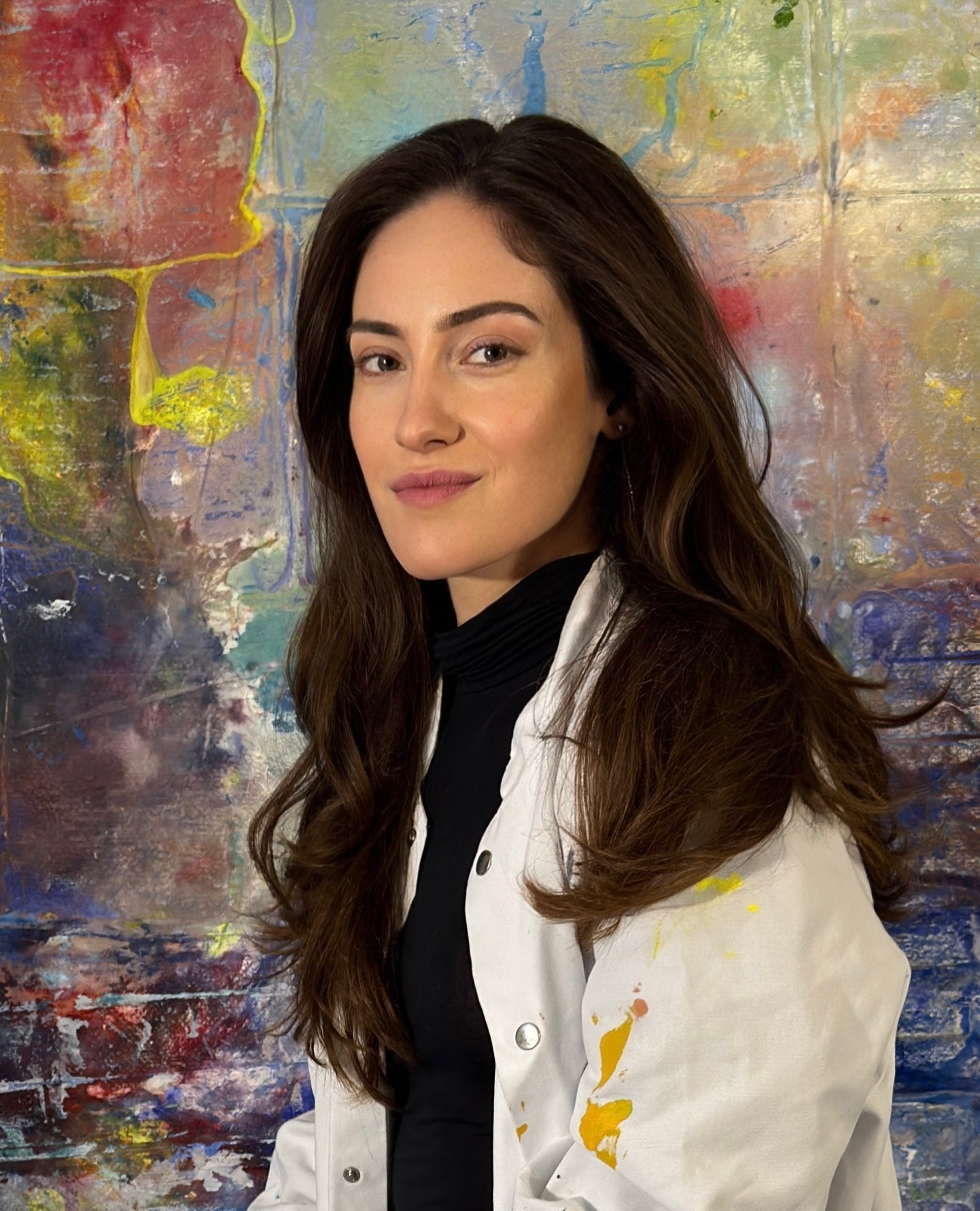
Anna-Belén Siegmann
“Painting, for me, is an act of authorship, identity, and intention. In a metaphorical sense, I see my practice as alchemy: the disassembling, extracting, and reassembling of materials to refine them and turn them into “gold.“ Therefore, the process of my work is as important to me as the finished painting.
My practice is informed by my earlier studies in psychology. I question reality in a dialogue between philosophical and spiritual themes, which I respond to on a physical level in my paintings. This, in turn, leads to new spiritual insights into reality, which I then react to again in my works. Hence, there are often many layers on top of each other in my work, and since my time at the Royal College of Art, I have started working in series and experimenting with painting in the expanded field.
I work extensively with liquid colors and experiment with combining them, allowing them to run into each other, then separating them by cutting up the work and putting it back together in a controlled order. This non-traditional way of painting creates a dialogue between the freedom ofexperimentation and the precision of control and intention. In this way, my work transforms into a dynamic conversation between the tangible and the intangible.”
Anna-Belén Siegmann (born 1997 in Hamburg), artistically known as Belén, is an emerging artist and graduate of the prestigious Royal College of Art in London. In 2021, Belén's work was selected for an exhibition at the Institut Français in Hamburg to celebrate the 70th anniversary of the institution in Germany. In 2024, she was selected for the exhibition "Mouvement", organised in collaboration with the French Consulate and the Institut Français in Hamburg. In the same year, she was awarded the Lucy Halford Scholarship for her Masters studies at the Royal College of Art in London. Her works are represented in public and private collections, including the prestigious private collection of Lord Davies of Abersoch CBE in London.

YaYa Yajie Liang
YaYa Yajie Liang’s painting practice revolves around the continuous metamorphosis of the body and the transformation of perception, seeking to establish a form of symbiotic alliance with nonhuman lifeforms and inanimate matter. Through phenomenological encounters with materials, landscapes, and diverse organisms, she approaches the body as an open, perceptual field of transformation rather than a fixed, enclosed human subject.
Her practice is informed by Roger Caillois’s theory of mimicry, though in Liang’s context, mimicry is not seen as disguise or evasion, but as an outward-facing sensory act—where the self, when drawn into contact with otherness, becomes permeable and morphologically altered. In her paintings, mimicry is not a replication of representation, but a becoming force: a dynamic interplay between body and nonhuman entities. Through the continual shifting and dissolving of form, mimicry becomes a pathway toward symbiosis and de-bordering.
For Liang, painting is a living organism. Colours and forms collide, overlap, and unfold across the canvas, generating unclassifiable figures within uncertainty. These ambiguous presences do not seek recognition but exist in a fluid state, inviting the viewer into a maze where distinctions between self and environment dissolve. Informed by Agential Realism and Queer Ecology, Liang resists centralized control in her practice, emphasizing the agency and guidance of matter in the painting process. She refers to this as the “third hand”—a force beyond conscious intention, transforming her role from controller to perceiver. Her works often emerge from embodied experiences—wandering, gazing, and touching the natural world. From fossilised marine life beneath the White Cliffs to the hidden mycelial networks of the forest floor, these nonhuman scales of time and structure are transposed into her paintings’ rhythmic flows and layered complexity. In her view, lifeforms do not exist in isolation; the human body is a geological composite of multiple nonhuman agencies, sedimented, metamorphosed, and reshaped across deep time. Within this co-creative field, the canvas ceases to be a passive surface and becomes an ecological site—painting itself a metamorphic experiment between body and material.
YaYa Yajie Liang (b. 1995; Henan, China) lives and works in London, where she is currently pursuing her PhD research in Painting at the Royal College of Art. Liang received an MA in Painting from the Royal College of Art, and a BA in Fine Art from China Central Academy of Fine Arts. Her recent solo exhibitions included Solo Presentation, Cob Gallery, NADA New York, New York, NY, USA (2024); I’m similar, not similar to something, but just similar at Galerie Kandlhofer, Vienna, AT (2024); Particles Maze at Lyles & King, New York, NY, USA (2024); Summer Palace, curated by Kat Sapera at Cob Gallery, London, UK (2023). Recent selected group shows include Tomorrow is Already Behind Us, Lyles & King, New York, NY (2025); Embodied Forms: Painting Now, Thaddaeus Ropac, London, UK (2024); Dante's Inferno, Unit, London, UK (2024); The Dance, Luce Gallery, Turin, IT (2023); Sweet Spot, BLANK Gallery, Shanghai, CH (2023); Universe 25, Gillian Jason Gallery, London, UK (2023); Wilderness of Being, HdM Gallery, London, UK (2022); Machines of Desire, Simon Lee Gallery, London, UK (2022); Beacon, Josh Lilly’s Gallery, London, UK (2020), among others. Liang has been shortlisted for The Waverton Art Prize in 2022.

Jason Stopa
"I make abstract paintings that reference architecture, decorative objects and coats of arms. My oil paintings are made of thin washes using archetypal, geometric forms that resemble a kind of flattened sculpture. Many of my works use ornamentation, lattice and framing devices set against arabesque form. I'm concerned with the tension between geometry and sensual form. My color belongs to a historical lineage. You can trace a color through-line from Henri Matisse to Bob Thompson to Stanley Whitney. Color used here is saturated, spatial and idealistic.
I am concerned with Modernist notions of progress. I’m also interested in mark-making as a form of language. I am after an abstraction that is two-fold: one that is critical of our notions of progress and also opens up a horizon of possibilities. I paint my monolithic forms with a severe aestheticism, privileging issues of touch and surface. My paintings address the pressure and density of pigment, and the manifold ways in which touch imbues a surface with a sense of personhood. I want my surfaces to emulate the washy, ceramic glaze of Ancient Greek pottery, which was in turn referencing Egyptian art.
In past exhibitions, I have painted wall installations of gates and stages. In these exhibits, the painted walls act as a stage for paintings to be hung on, whereas the paintings themselves are also a shallow stage. I’m interested in how mark-making can create physical and atmospheric sensations that vie with sculpture and perform a painting. In this way, my work seeks to question a painting’s status in relation to the wall and the social realities of a given architectural site."
Jason Stopa is a painter and writer who lives in Brooklyn. He has had solo exhibitions in Paris, Seoul, New York, and Istanbul. His paintings have been reviewed in Artforum, the Brooklyn Rail, Galerie Magazine, Hyperallergic, the New Criterion, and Vogue. He completed his BFA at Indiana University and his MFA at Pratt Institute in New York. Stopa is Assistant Professor of Fine Arts at the Fashion Institute of Technology (FIT) in New York. He is a contributing writer to Artforum, BOMB, Momus, The Brooklyn Rail, among other art journals.