Artists in Residence: September 2026
Alejandro Almanza Pereda
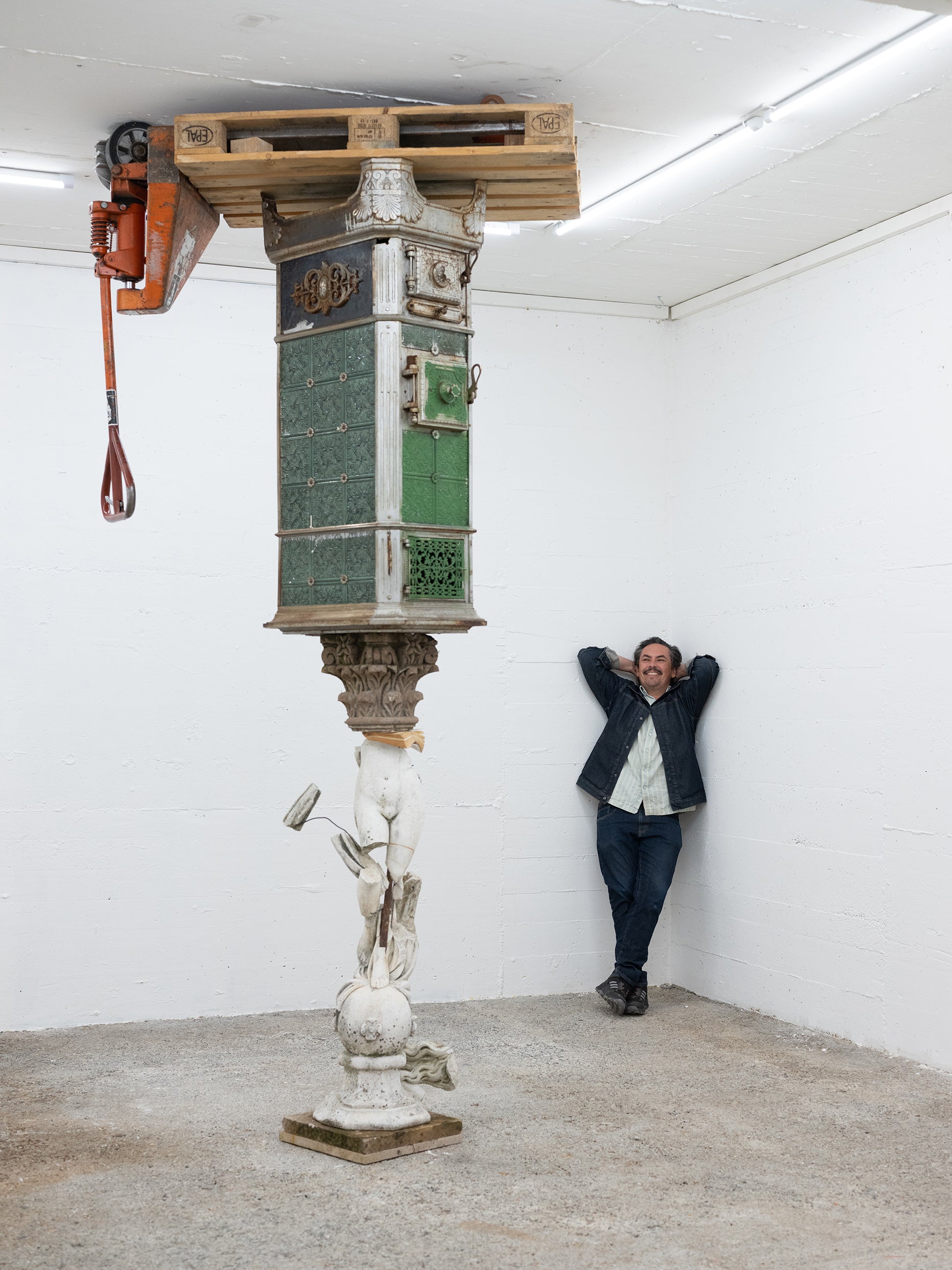
Alejandro Almanza Pereda makes sculpture, installation, and photography that leans on the relationship between precarity and solidity. His attention to the life forces in objects and material allows for allegorical understandings of the tentative balances perceived as resolute in contemporary social orders. His work typically focuses on the invisible power and influence that architecture imposes on everyday life. Pushing against modernist architects’ utopic ideals and outsized egos, he champions a life outside of architecture and social design.
His practice primarily is an exploration and play of gravity, material, tension, and humor. Everyday objects are at the core of the practice, manipulating their physical, metaphorical, and functional paradigmsconcurrently. The object arrangements and meaning-making recall Dutch Vanitas paintings, flea market collections, and amateur construction. His arrangements’ symbolic meanings remind viewers of the transience of life, the futility of pleasure, and the certainty of death, all with a wink of physical humor as an entry point into the work.
Resisting documentation of his larger installations, Almanza’s photographs result from an ongoing search for a different set of gravitational laws. This refusal of a singular reality led Almanza to build an underwater studio, creating a different reality with new dimensions and behaviors. The underwater photography tank allowed for object relations different from our everyday life and outside our typical realm of physics.
Holger Schmidhuber
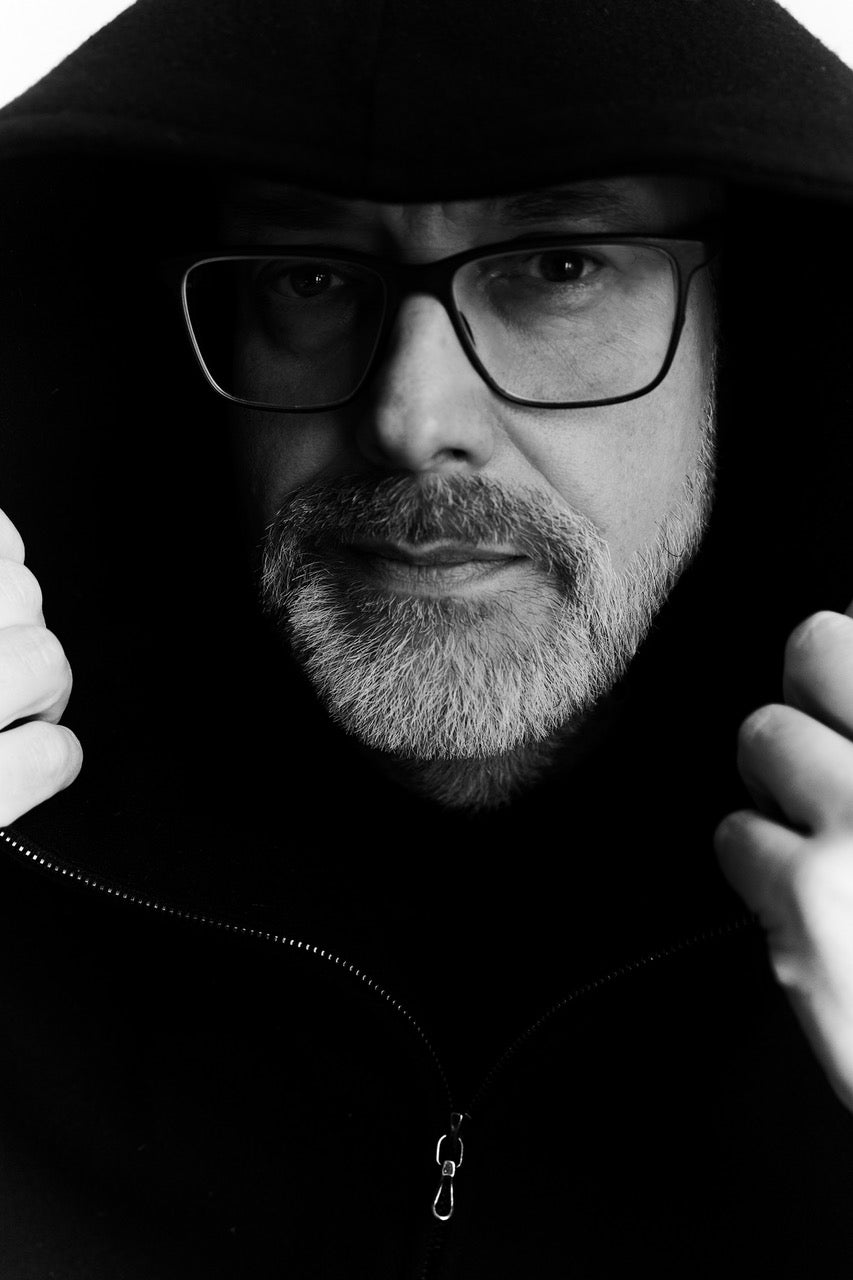
“My artistic practice operates at the limits of perception. I am interested in the agency of the visible and the invisible, and in the spaces between concretion and dissolution, memory and immediate experience.
My work may begin with specific places and photographic records, as well as historical objects, language, scientific models of thought, or digital systems. Through the artistic process, these elements are transformed and shifted into new contexts—onto a level that resists rational certainty.
Photography shifts towards the painterly, historical carpets open up into walkable pictorial spaces, language becomes a shifting matrix, and algorithmic structures become visual systems. Material is never merely the carrier of an idea, but an active part of artistic thinking. Pigments, lacquers, glass particles, textile structures, and phosphorescent layers of paint develop an agency of their own. Light, perspective, and movement alter the works: what appears clear and distinct in one moment may shift, dissolve, or re-form in the next.
A fundamental principle of my work lies in the tension between precision and loss of control. Technically and conceptually developed systems encounter intuitive, gestural, and not entirely predictable processes. From this friction, moments can emerge in which something opens up that cannot be fully grasped through our familiar systems of thought and perception.” – Holger Schmidhuber
Cynthia Gutiérrez
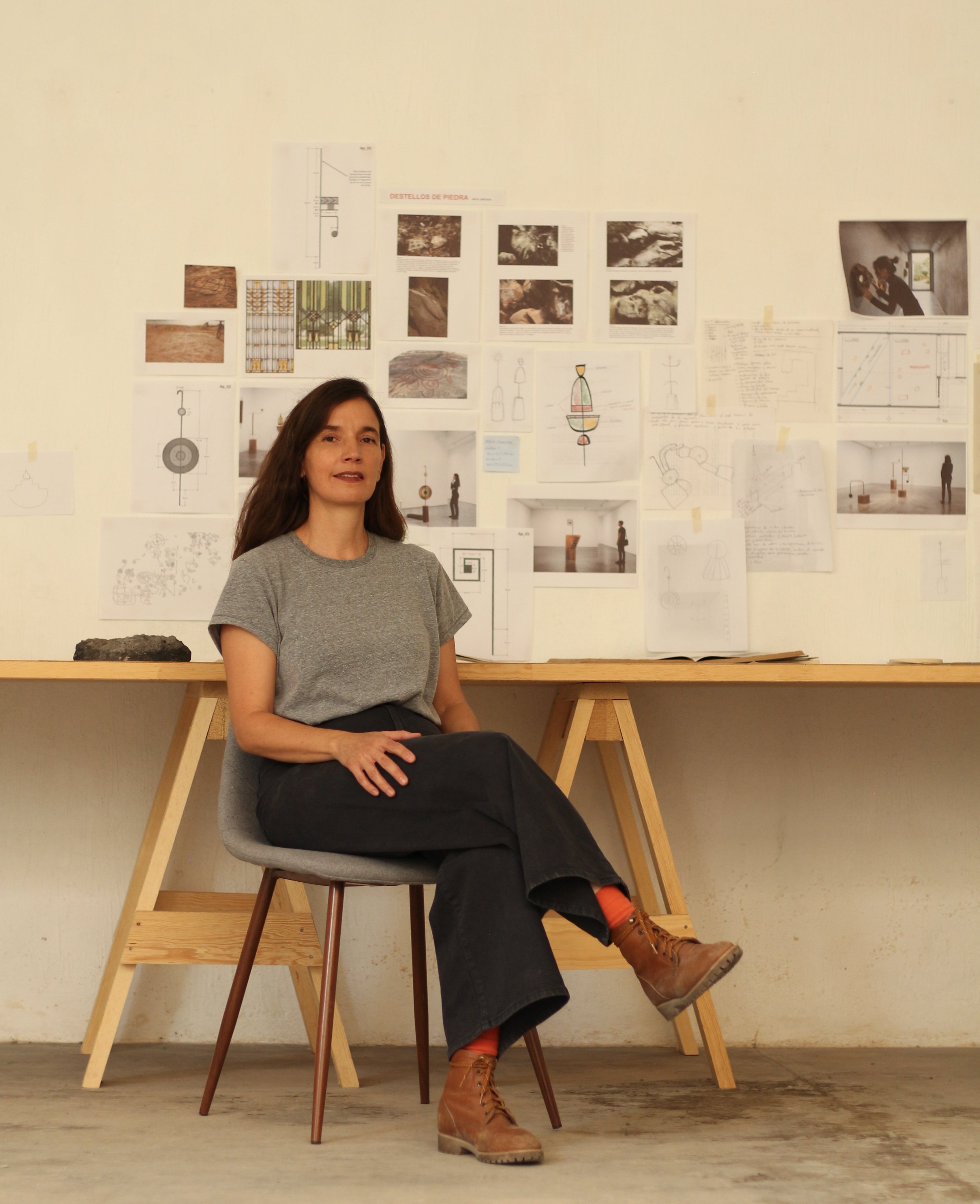
“In a search constantly in tension linked to concepts such as identity, memory, ruin, failure, history and collapse, my work intends to question the established schemes that condition us. My reflections and processes depart from situations of conflict, sinuous, unstable, and indefinite terrains, with a vulnerability that allows movement in multiple directions. In an effort to fracture structures, to dilute edges, to push things to the limit, to surpass or twist borders, the impulse of my pieces lies in the awareness and analysis of context and memory.
Retrieving fragments with certain historical weight, I attempt to rearticulate, from a different posture, their potential significance through visual elements that seduce the eye. Thus, I use the illusory nature of art as an instrument to alter the habitual course of things, in a perverse recomposition where reality and fiction merge to reveal the inconsistency of history, which is always a distorted image that we construct.” —Cynthia Gutierrez
Cynthia Gutiérrez’s work is articulated from an understanding of sculpture beyond the medium. Her approaches to three-dimensionality— through different supports—arise from a critical strategy that seeks to question and test the vulnerability and stability of that which is structural, whether at a physical, conceptual or political level. Supported by different philosophical references, the query about the future vibrates in a deep layer in Gutiérrez’s work. The relationship between past and present, between the institutional as epitome of power and control structures, as well as the different forms of political representation inhabit her work to set up a dialogue that allows us, if not to resort to answers, to at least act from an awareness of the tensions we face. In this way, the construction of memory, of national identity, the idea of progress or failure, the cyclicality of collapse, the apparatus of legitimization, and its link with art and culture are frequently addressed in her pieces to interrogate and test our ability to discern and negotiate the public, political and social space.
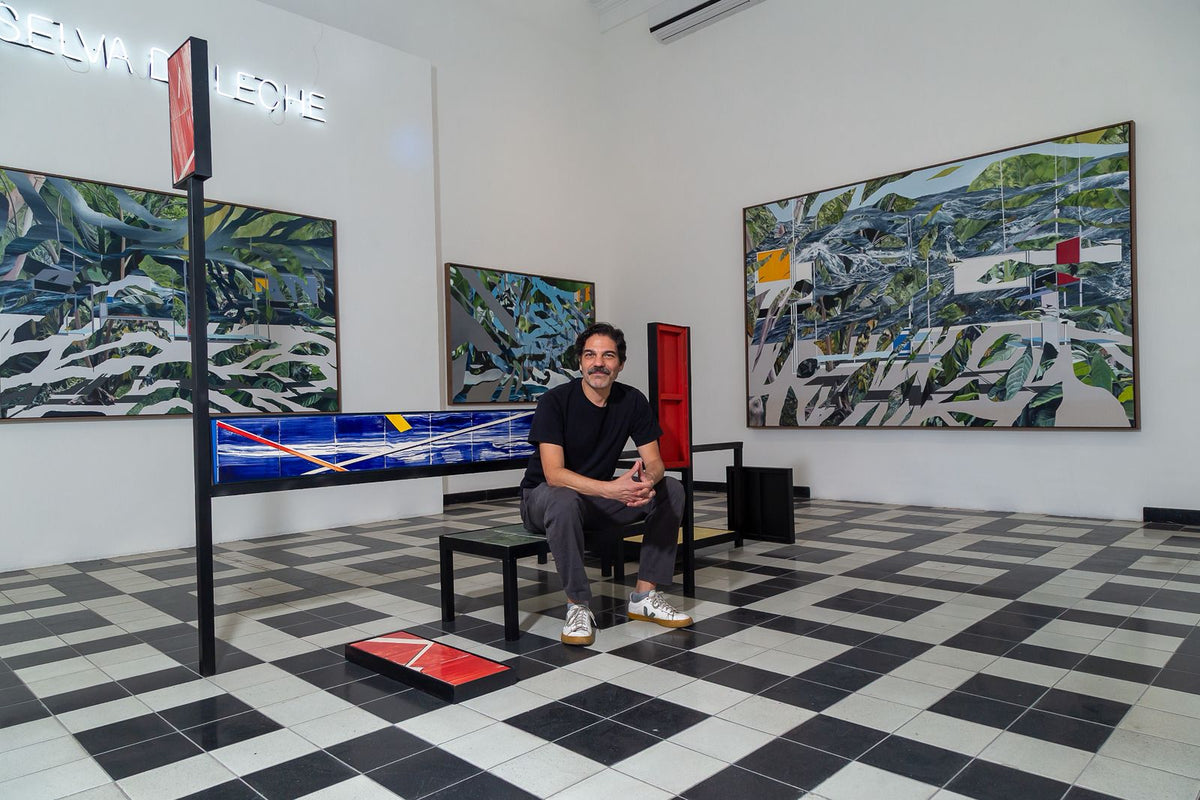
Luis Alfonso Villalobos
Luis Alfonso Villalobos is a visual artist whose practice brings together painting, sculpture, ceramics, objects, and installation. Trained as an industrial designer, he has developed a language that connects image with support, structure, and spatial arrangement, expanding painting into more complex relationships with architecture and material culture.
His work examines the tensions between nature and artifice, emphasizing their shared vulnerability and the ways in which landscape, design, and built forms continually shape one another. Vegetation, shadow play, bodies of water, architectural fragments, furniture, and modern structures coexist within his compositions as vestiges of an absent human presence embedded in scenarios of decay and reconfiguration. From this perspective, Villalobos reflects on the fragility of systems of control, with particular attention to the domestication of the environment and the material persistence of the objects and spaces produced by culture.
In his recent work, this line of inquiry has focused on the collapse of certain promises of modernity, the territorial memory of agriculture, and the traces left by construction on the landscape. His latest works present an imaginary in which geometry, ornament, ruin, jungle, and garden coexist in compositions that challenge and dissolve the boundaries between the organic and the built. Through these intersections, his practice offers a critical reading of the relationship between ecology, architecture, and extractive economies, attending equally to the formal qualities of the work, the symbolic charge of its imagery, and its historical and political resonances.
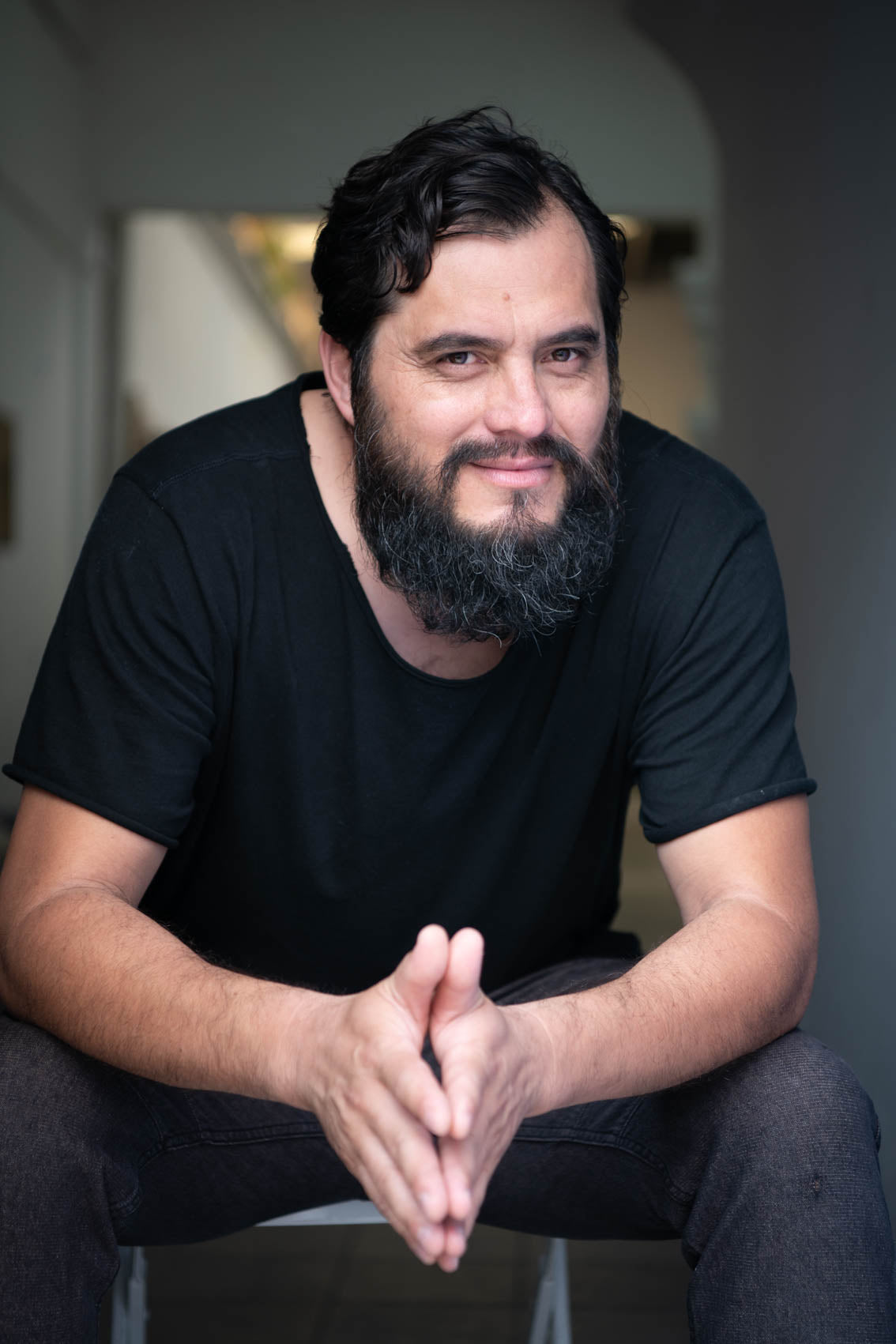
Emanuel Tovar
Emanuel Tovar is a multidisciplinary artist who explores and expands the limits of sculpture, performance and installation. Through his work, he constructs and recreates images through which he opposes the sublime and everyday life as a critical strategy, from a very personal and poetic language, almost sustained by a tragic beauty. Body, space and everyday objects are united to then abstract and return them to the public -in simple situations, scenarios or vestiges that evoke landscapes and small narratives- as interrogations about working life and the political, economic, cultural and philosophical implications that surround it in different contexts. From materials that are frequently linked to physical labor such as clay, coal, or cement, Tovar’s works take forms that change and are presented in different stages of their (re) production. Sometimes his actions pose moments of encounter and depth for the viewer and become installations or sculptures, in others, the sculptural cites the trace of a performativity encapsulated in the material and the object.
From the observation of physical labor and its socio-economic and urban environment, Tovar articulates a series of reflections in relation to the body as a political territory. In the spaces in which the artistic work is framed, he activates and questions the creative and intellectual relationships of the art world as well.