
Artists in Residence: June 2026

Maxwell Williams
Maxwell Williams is a multi-disciplinary olfactory artist, researcher, DJ/producer, and writer based in Los Angeles. Williams’ work placessmell in the context of performance, research, sculpture, and photography to explore a personal history of techno and gabber raves, global trade routes, heartbreak, and the physiology and psychology behind the hedonics of scent.
They have presented work at the Museum of Contemporary Art (MOCA), Los Angeles; Craft Contemporary, Los Angeles; Olfactory Art Keller, New York; The Institute for Artand Olfaction, Los Angeles; Chateau Shatto, Los Angeles; Honor Fraser, Los Angeles; The Experimental Scent Summit, London; and Mediamatic, Amsterdam.
Tamara Arroyo
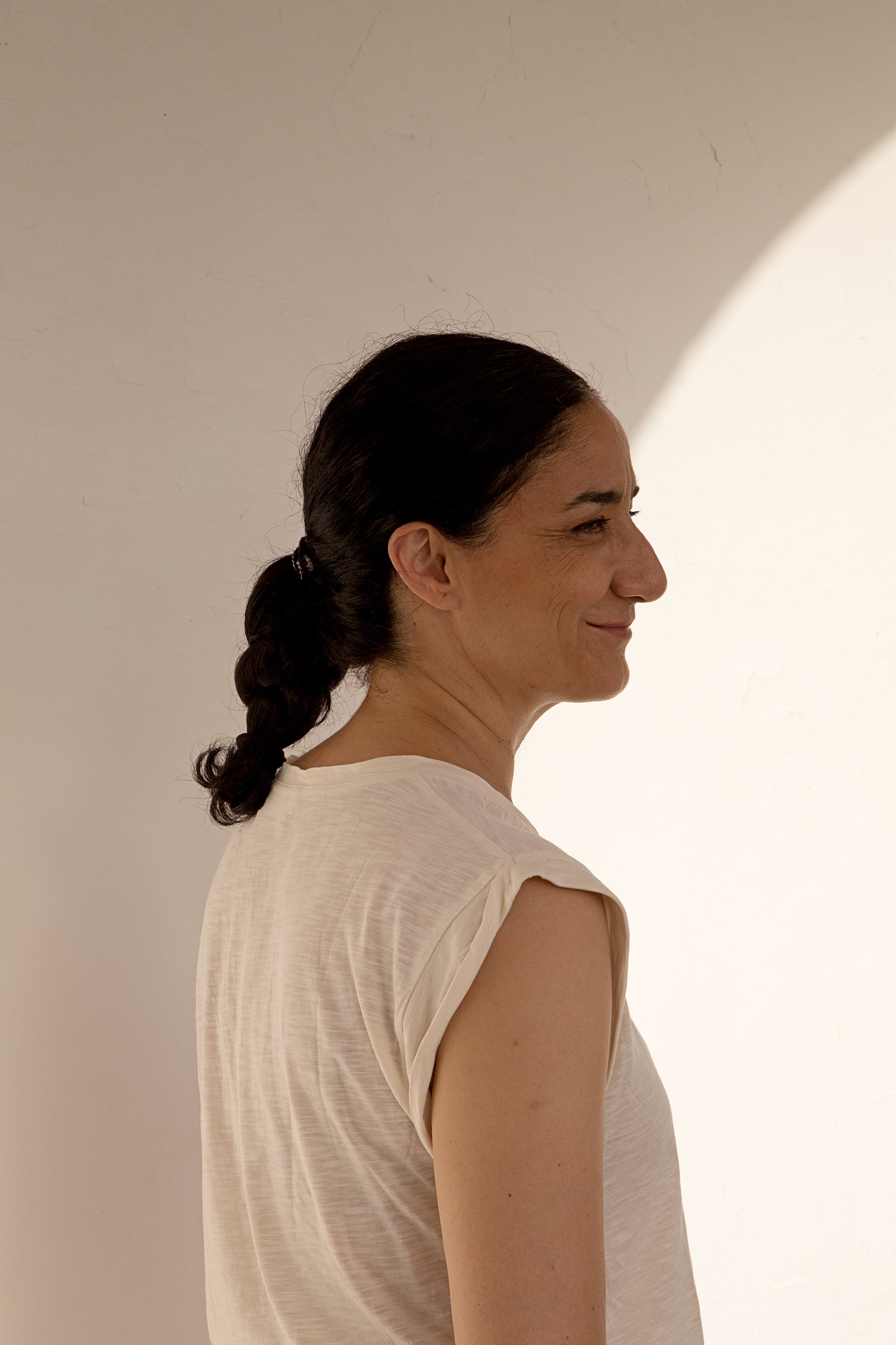
"My sculptural imagination takes root in my daily walks through the city. The decision to transform one urban element or another—a construction fence, a streetlamp, or a piece of cardboard or plastic—into a sculpture monumentalizes the uses of the urban and the domestic; that is, those seemingly minor elements that give rise to a genuine form of social interaction. In my work, there is a recurring focus on the image of places and their appropriation through art. The urban locus, public space, is the point of reference I use in my latest projects to observe the architectural processes resulting from social conditions in the construction of space. The public sphere, as a privileged space of everyday life, is a repository of signs of identity and creative potential. I explore the ways in which the environment and architecture influence their inhabitants. And I emphasize the mental states that arise from our relationships with our immediate surroundings, such as a sense of belonging, identity, and critical awareness. In an effort to encourage the viewer to experience different sensations, perspectives, and interactions with their environment." — Tamara Arroyo
Bianca Phos
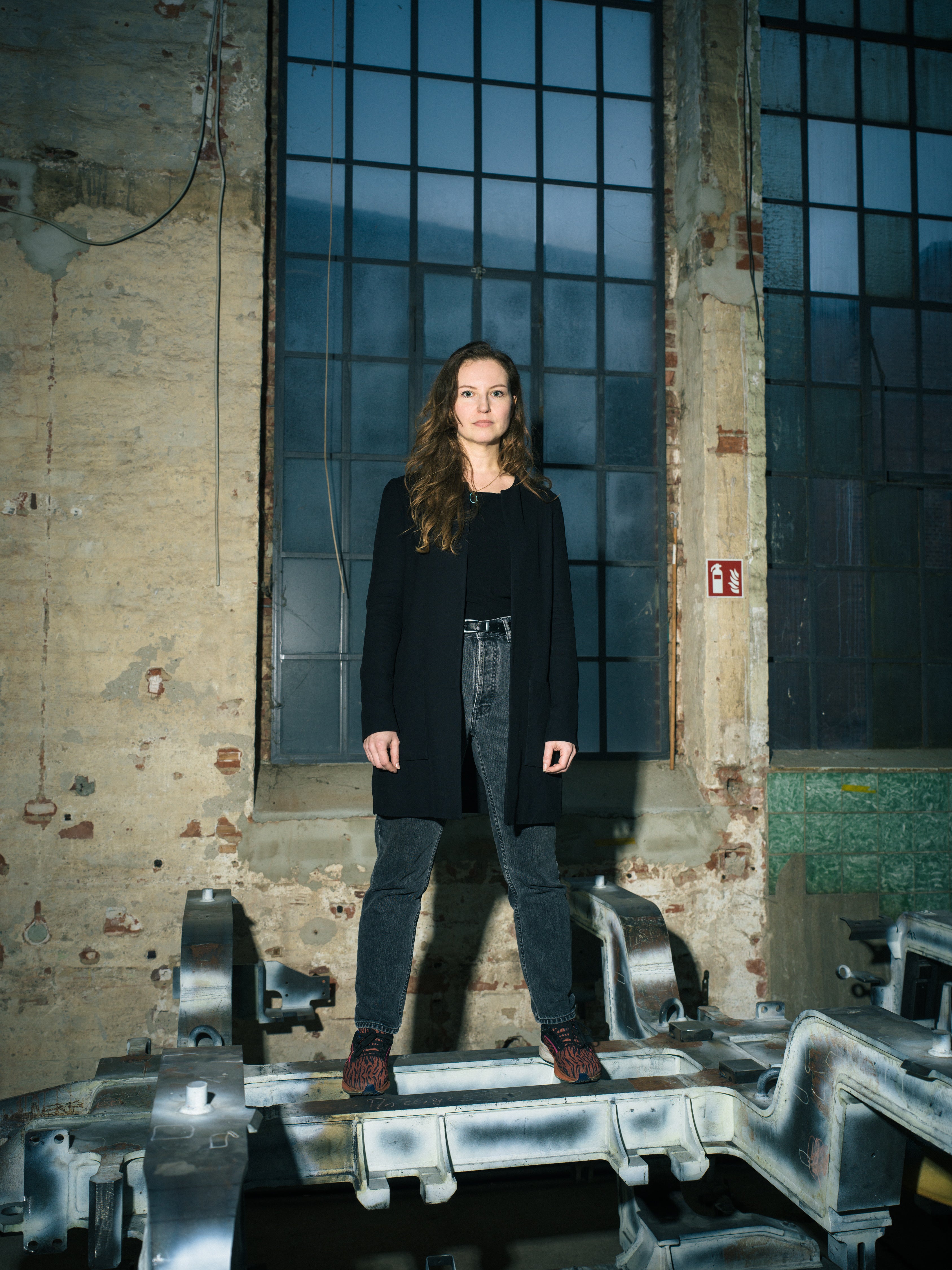
Bianca Phos’s artistic practice unfolds between installation, sculpture, drawing and printmaking. In her work, embodiment appears as a porous, unstable condition shaped by technological, ecological, and epistemic systems — by tools, structures, expectations, and other bodies. Often beginning with material encounters — with surfaces that receive, resist, or transform a gesture — her practice attends to moments where knowledge systems are inscribed in matter, and where matter, in turn, can unsettle or revalue them. Her works take shape between mark and measure, support and obstruction, where perception, materiality, and systems of meaning begin to shift, overlap, and renegotiate the conditions of separation and relation.
Based in Vienna, Phos studied ‘Textual Sculpture’ and ‘Art and Time / Video’ at the Academy of Fine Arts Vienna, complemented by studies at HFBK University of Fine Arts Hamburg and Bezalel University of Art and Design Jerusalem. Her work has been presented in major Austrian institutions, including Bank Austria Kunstforum Wien, Kunsthaus Wien, Belvedere 21, Universalmuseum Joanneum, Graz, and MUMOK, Vienna, alongside exhibitions at Zeller van Almsick, Vienna; Kunstforum Montafon, Schruns; Bildraum 07, Vienna; Galerie Fünfzigzwanzig, Salzburg; Galerie XY, Olomouc; and Techne Sphere, Leipzig, among others.
Li Jun
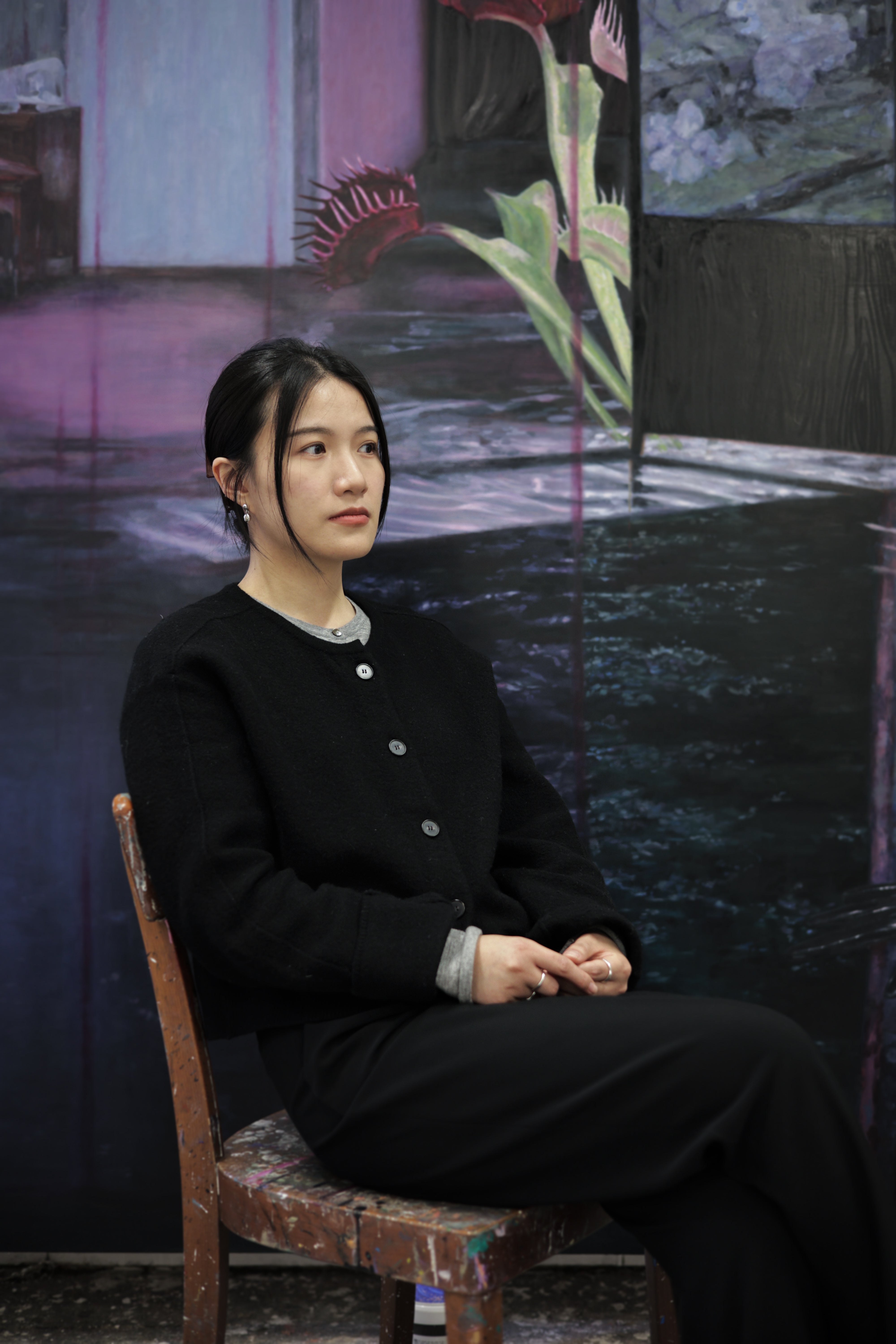
Li Jun’s paintings are organized around a sense of suspension, a fascination with how objects continue to exist in the absence of humans. In her work, objects, partial bodies, and spatial structures recur, forming relationships that both contain and constrain. These elements function simultaneously as vessels and as boundaries: they receive emotion while delaying its direction. The things she paints carry histories, of use, of association, of circulation within visual culture. But in her paintings, they are suspended from those histories, growing within relations that generate pressure without resolving into narrative. This growth happens inside a particular space, an interior world shaped by her experience as a woman, by the overlapping of Eastern and Western visual traditions, and by the histories of cultural exchange and power that run through both. The figure is about to leave, has just left, or exists only as the pressure an absence exerts on a room. These spaces do not illustrate experience, they are the shape experience takes, holding inherited visual conventions at a distance close enough to recognize, yet strange enough to unsettle. Her paintings do not explain this process. They are the process.
Li Jun (b. 1994, Changsha, China) completed her studies at the China Academy of Art in Hangzhou and is currently pursuing studies at the Academy of Fine Arts Vienna, where she works in the class of Daniel Richter. Recent presentations include exhibitions at Zeller van Almsick, Vienna; Gene Gallery, Shanghai; ZÉRUÌ, London; and Tang Contemporary Art, Beijing (all 2025), as well as multiple exhibitions at Turn Gallery, New York (2021, 2022, 2024, and 2025). Li Jun is represented by Zeller van Almsick in Vienna. Her work has been recognized with grants from the Elizabeth Greenshields Foundation (2024, 2026).